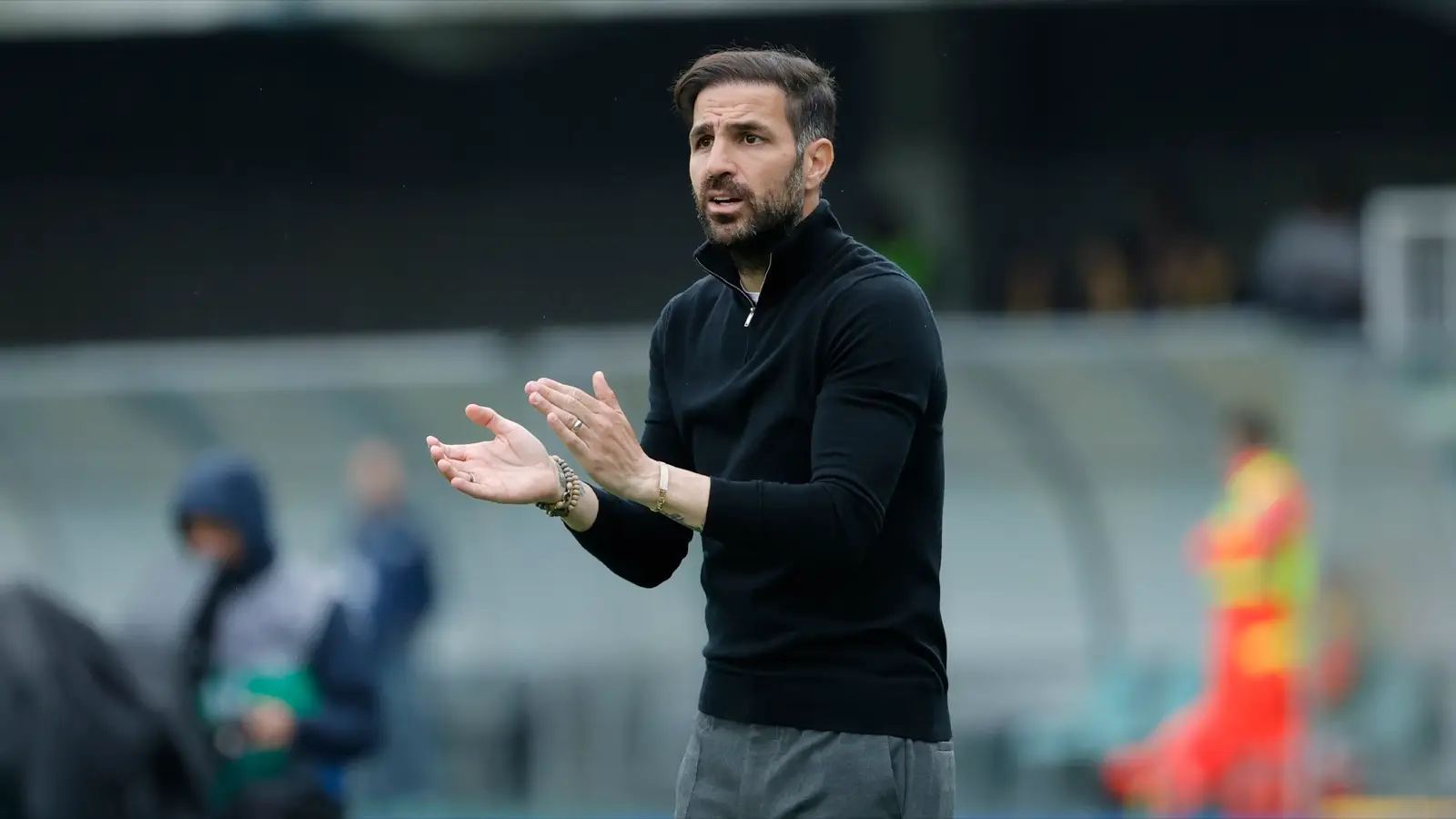
At the Emirates Stadium, Cesc Fàbregas spent Como’s preseason draw with Arsenal working the edge of his technical area in a compact black crewneck T-shirt tucked into high-waisted taupe-gray trousers. Two front pleats opened into a broad thigh; the long hem settled lightly over clean white sneakers. When he extended his right arm toward the pitch, the shape held: close at the shoulders, open from the waist down. The game finished 1-1 before Arsenal won the shootout 4-3.
The outfit looked singular, but it wasn’t isolated. Across Como’s recent touchlines, Fàbregas has developed a repeatable system that suits Como’s larger club project : a fitted tee, polo or knit above; trousers cut generously through the thigh and leg below; white low-top sneakers at ground level. Pleats, a full break and occasional light pooling do much of the work. The identifying feature is proportion, not a visible label.
The progression tracks his changing place at the club. He arrived as a player in 2022, retired the next summer and began coaching Como’s Primavera side. At his 2023 transition ceremony, he wore a royal-blue T-shirt, dark jeans, black athletic shoes and a cap. Club-issued technical tops and jackets dominated the official imagery around his 2024 appointment on a four-year contract. By 2026, after a 10th-place Serie A finish and then qualification for Como’s first Champions League campaign, the civilian wardrobe had become coherent.
His football supplies a vocabulary for reading those clothes. Fàbregas teaches “space, time and posture” and insists players should decide their next pass before the ball arrives. At Como, he has described a proactive game built on possession, high pressing and intelligent transitions. Como’s plan around Nico Paz offers one practical expression of that thinking: clear reference points without reducing the player to one answer. A wardrobe can’t prove tactical intent. Here, the visual rhythm is simply comparable, with a controlled frame and room to move.
The touchline has several overlapping dress codes. The suit and overcoat project civil authority. The tracksuit projects technical authority. Crest-heavy training wear doubles as a broadcast and commercial surface. Fàbregas now occupies the contemporary hybrid: knitwear, field jackets, relaxed tailoring and minimal sneakers. Ties, formal leather shoes and conspicuous patterns are largely absent from the mature civilian looks, while a full club tracksuit is an option rather than the default.
The work inside the ease
Sprezzatura is useful here only if the word keeps its history. In Book I of The Book of the Courtier, first printed in 1528, Count Ludovico da Canossa proposes a cultivated nonchalance that conceals artistry, avoids affectation and makes difficult action appear unforced. It was a courtly instrument of grace and persuasion, not a synonym for any stylish Italian outfit. Modern menswear compressed the idea into studied nonchalance, often a deliberate irregularity in the way clothes are worn. The effect becomes sprezzatura-like only when deliberate selections fade behind apparent ease. It says nothing certain about his intention.
The repetition matters more than any single combination. Black, navy, charcoal, gray, stone, cream, muted olive and brown keep the palette narrow. Across the sample, tees and polos sit beside fine knits, quarter-zips, cardigans, utility jackets and weather layers without changing the underlying outline. Accessories remain restrained. Even when trousers carry cargo pockets or the hems gather more heavily at the shoe, the compact-above, generous-below balance survives.
Lake Como invites the camera to drift toward scenery, but Fàbregas has called coaching there “a proper job.” The distinction keeps the clothes honest. A technical area requires standing, crouching, turning, walking and sudden gestures through heat, rain and cold. His softer tailoring absorbs those demands without reverting to office formality or surrendering to head-to-toe training wear.
Como enter their first Champions League season with Fàbregas established as both coach and public face of the side. His touchline clothes don’t mimic a midfielder’s decisions, and they don’t need to. They solve a related problem in another language: how to create definition without stiffness, and how to preserve space for the next action. The manager’s new uniform doesn’t announce authority. It lets authority move.