
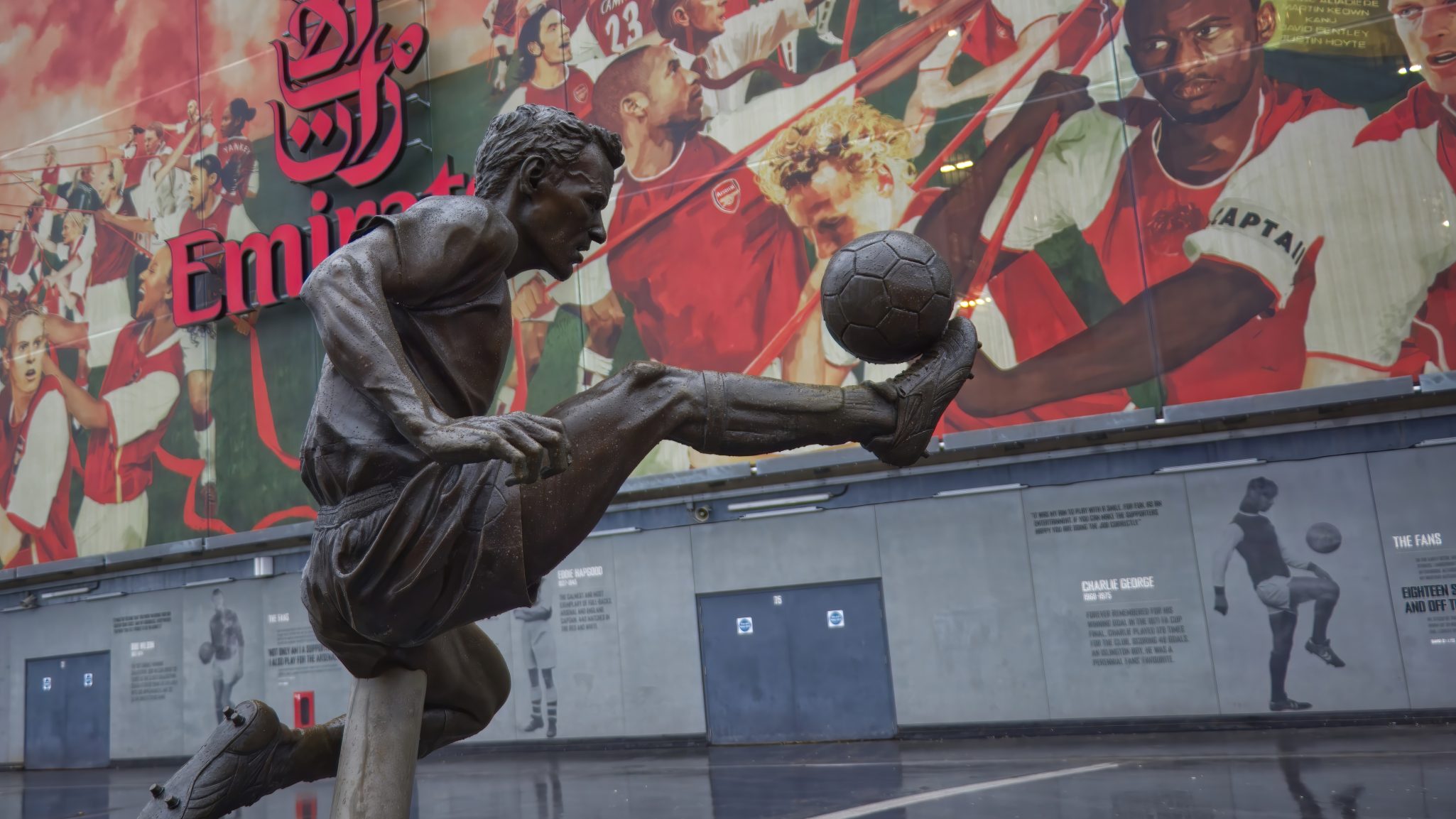
Dennis Bergkamp’s reputation was never built on volume alone. He scored 87 goals and produced 94 assists in 315 Premier League appearances for Arsenal, numbers that mark a great forward, but they still don’t explain why he occupies such a distinct place in football memory. What set him apart was the feeling that a match moved at his speed when the ball reached him. The Premier League’s Hall of Fame page describes his 1995 arrival as the introduction of “a new level of skill,” the kind that helped carry Arsenal to three league titles and widened the league’s imagination about what a forward could be.
That’s why Bergkamp’s aura is best understood through moments rather than totals. For all the excellent goals scattered across his career, two have become the clearest shorthand for what made him different: the turn and finish against Newcastle United in March 2002, and the late winner for the Netherlands against Argentina at the 1998 World Cup. One belongs to his Arsenal life, the other to his international career. Together they show the same qualities under different forms of pressure.
The Newcastle goal remains the definitive club image. Arsenal’s own archive places it inside a title race, noting that Bergkamp scored after 11 minutes at St James’ Park in a 2-0 win that proved invaluable in the run to the Double. The Premier League later elevated it even further, saying the strike was voted by fans as the best goal in the competition’s first 25 years. That matters because the goal was not remembered only as a flourish. It arrived in a season that ended with Arsenal as champions and FA Cup winners, which gave the beauty of the move competitive weight.
What makes that goal endure is the way it solves a crowded problem in a single motion. Bergkamp receives the ball with his back to goal, a defender tight to him, and no obvious path through. Then the touch does two things at once. It moves the ball around Nikos Dabizas and turns Bergkamp into the space on the other side. Bergkamp later described it with the plainness that often accompanied his finest work: “It all started with a pass behind me,” and then, once he had flicked it and turned, “the finish was never going to be a problem.” The quote is useful because it shows how he saw the move, not as theater, but as a technical answer.
That sense of control sits at the center of Bergkamp’s aura. Patrick Vieira, speaking in the Premier League’s PL30 series, said Wenger built the team around him because “He’d do things on the field that push people to fall in love with the game.” The line is exact, but it also helps clarify the larger point. Bergkamp didn’t impose himself through force. He imposed himself through decisions, through angles, through the ability to make a defender feel late before the defender had even understood the danger.
Where the aura meets consequence
If Newcastle is the club monument, Argentina is the international one. FIFA still frames the strike as one of the best goals in World Cup history, and its own description of the moment remains the cleanest: a long pass from Frank de Boer, control with the first touch, escape with the second, finish with the third. The match was the 1998 World Cup quarterfinal, the Netherlands beat Argentina 2-1, and Bergkamp’s goal came in the 90th minute. UEFA’s retrospective called it the goal of the tournament.
The difference between the two goals is not quality but setting. Against Newcastle, Bergkamp turns pressure into geometry. Against Argentina, he does the same thing with a semifinal place at stake and almost no time left. The pass from de Boer is long enough to invite uncertainty, but Bergkamp’s first touch removes it. The second touch creates separation without excess movement. The third finishes the move before the defense can recover. In that sequence, the calm that defined his league career survives the most compressed kind of international pressure.
There is one useful complication. Bergkamp himself did not call Newcastle his favorite goal. When he was inducted into the Premier League Hall of Fame in 2021, he said, “A lot of people would pick my goal against Newcastle,” but his own choice was the third goal of his 1997 hat-trick against Leicester because “every move went how I’d planned it in my head.” That detail strengthens this argument rather than weakening it. Newcastle and Argentina are not simply the goals Bergkamp prized most in private. They are the goals that most completely reveal him in public.
That is why these two moments still carry the whole outline of his reputation. They are not just beautiful goals, and they are not famous only because they were replayed for years. They show the same rare trait in two different arenas: Bergkamp’s ability to make elite football look as if it had already been decided in his mind. Newcastle gave Arsenal the purest club version of that gift. Argentina gave the world-stage version. Put together, they are the clearest explanation of his aura.