
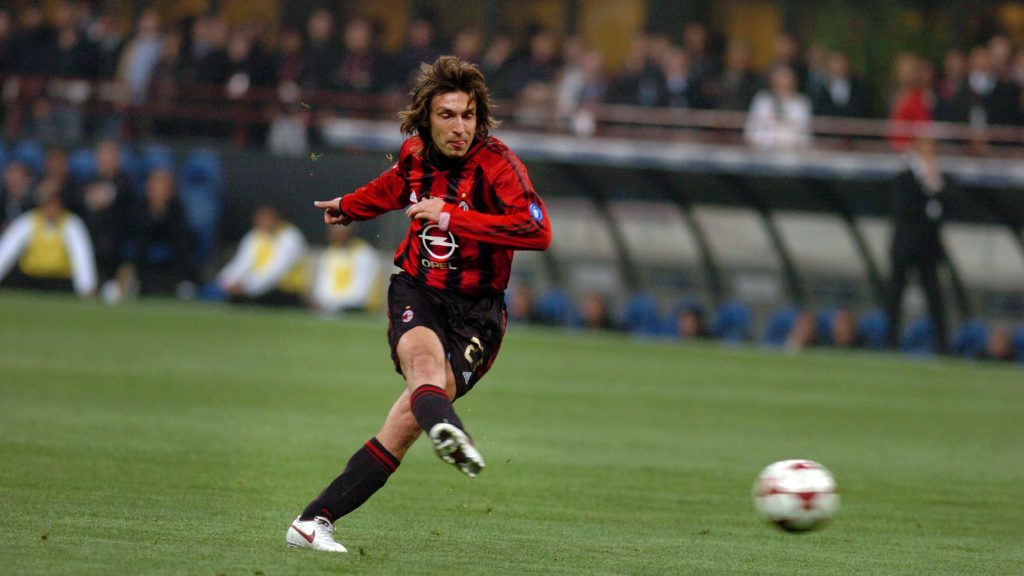
Pirlo’s gift was that he made elite football look premeditated. His own explanation remains the best place to start: “Football is played with the head. Your feet are just tools.” That line gets at the center of his appeal. He didn’t impose himself through speed or force. He seemed to arrive at the right answer before the rest of the field had finished reading the question.
That version of Pirlo was not there from the beginning. He came through Brescia as a fantasista, struggled to establish himself at Inter, and changed course only when Carlo Mazzone moved him deeper during a loan spell back at Brescia. Carlo Ancelotti continued that shift at Milan, and Milan’s own historical record says the move from attacking midfielder to deep-lying playmaker helped turn him into one of the best in the world.
Once he settled into that role, Pirlo began controlling matches from a part of the field that usually isn’t treated as glamorous. At Milan he played 401 matches and scored 41 goals. Official club and UEFA material credit him with two league titles and two Champions Leagues there, along with a period in which his balance and rhythm shaped the team’s identity. He wasn’t just passing neatly from deep. He was determining the pace and geometry of the match.
By the summer of 2006, he was central to Italy’s World Cup side. FIFA’s retrospective credits him with Italy’s first goal of the tournament against Ghana, four assists, and a tournament-high three man-of-the-match awards, including the final. The signature moment remains the disguised pass for Fabio Grosso against Germany in the semifinal, a play that distilled what made Pirlo so unusual. He could make the most difficult decision in the match look like the most natural one.
His move to Juventus in 2011 only sharpened the case. Juventus’ own figures from 2012-13 show 98 passes per game, five free-kick goals, the most successful passes in Serie A, the most passes played in both the middle and final thirds, and 96 chances created for Juventus. Those are not decorative numbers. They describe a player who functioned as an organizing principle.
He didn’t speed matches up. He made them wait for him
Euro 2012 may be the clearest expression of the aura. Pirlo was 33 and still at the center of Italy’s game. UEFA credits him with an assist against Spain, a free-kick goal against Croatia, a corner converted by Antonio Cassano against Ireland, and man-of-the-match awards against Croatia, England, and Germany. Against England, he completed more passes on his own than England’s entire midfield, then scored the chipped penalty that altered the shootout’s mood and direction.
What separated him from other great midfielders was not just range or technique. It was the feeling of certainty he created. Marcello Lippi called him “a silent leader. He speaks with his feet.” Zbigniew Boniek said passing to Pirlo was like “hiding it in a safe.” Those are exact descriptions of the same quality. Teammates trusted him with the shape of the match because he never seemed to lose the measure of it.
That’s why Pirlo’s aura still feels singular. He played from deep, rarely hurried, and yet he could dominate the tone of a game more completely than many attacking midfielders or forwards. He made intelligence visible. He made delay feel purposeful. And he turned one of football’s most structural roles into something that looked like style.