
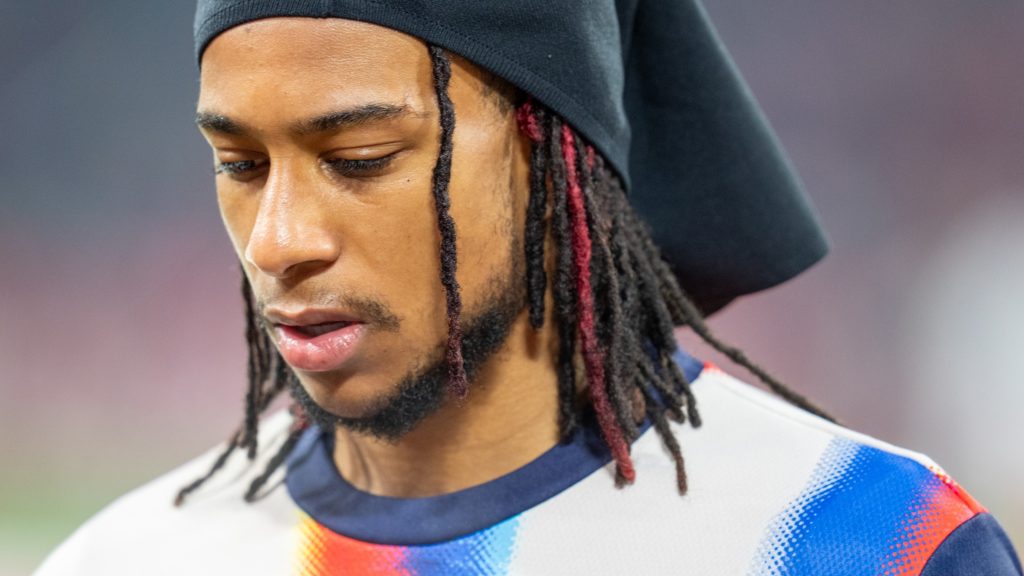
Michael Olise has become one of the most watchable attackers in Europe while staying oddly detached from one of modern football’s most predictable systems. In October 2025, L’Équipe profiled him as an anti-star, noting that although he wears Nike boots, he did not have a sponsorship deal with an equipment manufacturer and was not the face of any brand. That is the foundation of the story, not rumor, not mythology, and not some throwaway detail from boot culture. It is a reporting point that tells us something larger about how Olise moves through the game.
What makes that detail worth more than a novelty item is timing. Olise is not an unsigned player waiting for his breakthrough. He is already at Bayern Munich, already central to one of the biggest clubs in the sport, and already producing at a level that would normally attract every layer of football’s commercial machinery. This season, he has posted 11 goals and 18 assists in 26 Bundesliga appearances, along with three goals and six assists in 10 Champions League matches.
That makes the lack of a boot deal harder to dismiss as a gap between contracts. It looks more like a choice that has held firm while his status has risen. Even the way he has approached boots points in the same direction. Olise has often been associated with older Nike models rather than the newest heavily marketed releases, which suggests a player more interested in comfort, familiarity, and personal preference than in becoming part of a product cycle.
The deeper point is that Olise’s career has already been described as a carefully managed project. Reporting on his rise to Bayern has emphasized the degree of thought that went into his path, with those around him taking a measured approach to each step. Read alongside L’Équipe’s anti-star profile, the sponsor question starts to look less like eccentricity and more like continuity. The same instinct that shaped his football decisions may also be shaping his commercial distance.
That reading becomes even more interesting when you look backward. In December 2020, reporting around AC Milan said Paolo Maldini wanted to sign Olise from Reading and then loan him to a Serie B side so he could adapt to Italian football and life. It was a classic big-club development idea, structured, strategic, and institutionally controlled. Olise did not take that route. He stayed in England, moved from Reading to Crystal Palace, and later arrived at Bayern as a more fully formed player.
The through-line is control
Not rebellion for its own sake, and not some romantic rejection of modern football, but control. Olise’s story is not that he stands outside the elite game. It is that he has reached the center of it without surrendering every part of himself to the standard script. Clubs identified him early. Big institutions saw his value. Yet the shape of his rise still feels unusually self-directed.
Even his boots reinforce that idea. In most cases, elite players become brands almost as quickly as they become stars. Olise, by contrast, often looks like someone dressing for performance and personal preference first. The older models, the absence of a visible manufacturer push, all of it gives the same impression. He is not anti-style. If anything, he seems highly aware of style. He just appears unwilling to let a sponsor define it for him.
That is why the sponsor detail matters. On its own, it is a curiosity. Set against his production, L’Équipe’s profile, the broader reporting on how carefully his career has been managed, and the earlier Maldini interest, it starts to look like one of the clearest clues to who Olise is. In a sport built to package talent as quickly as possible, he has become an elite player while keeping unusual control over the way he is presented. That may not be the whole Michael Olise story, but it is now too consistent to ignore.