Presented by Amazon
For years, the story of Colombian women’s football has been told through bursts of international visibility, a World Cup run, a breakout star, a title season that seemed to promise something bigger. The harder question has always come after that. What lasts, and where does the next layer of progress take shape?
Part of the answer now sits inside the NWSL.
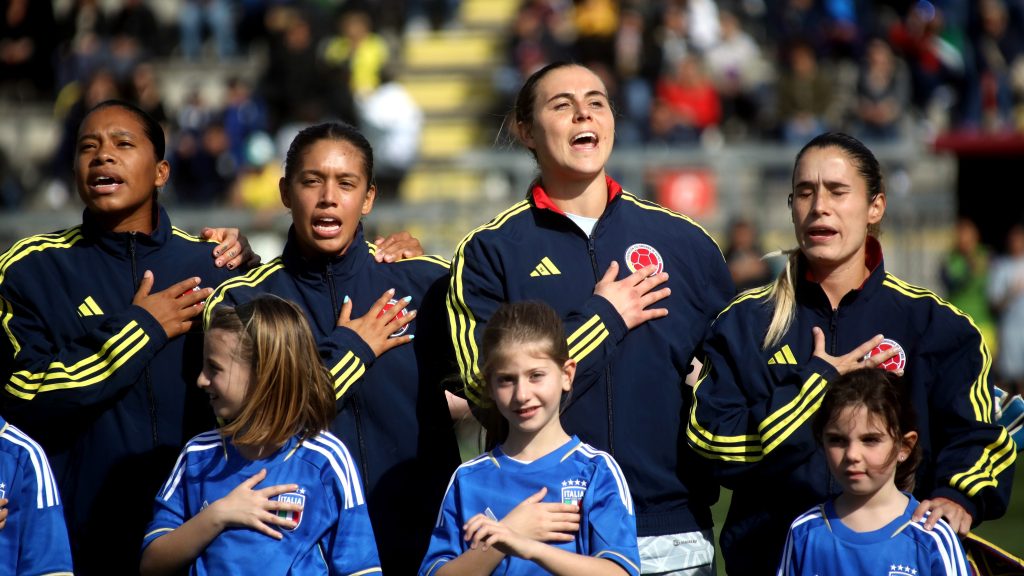
By the opening stretch of the 2026 season, Colombian players were spread across multiple clubs in the league. Washington Spirit midfielder Leicy Santos remained the most established name in the group. Boston Legacy added defender Jorelyn Carabalí ahead of its inaugural season. San Diego Wave carried both defender Daniela Arias and goalkeeper Luisa Agudelo. Chicago Stars had forward Ivonne Chacón on the roster, and Portland Thorns continued to develop teenage attacker Valerin Loboa. Official club and league materials confirm Colombia’s presence across five NWSL teams, a footprint that says something meaningful about where the country’s talent now sits in the global game.
That matters because the Colombian domestic league has never moved in a straight line. In the Athletic piece, Santos describes the first professional season in 2017 as a turning point, then immediately places it inside a larger unfinished project. “There are still many things we need to improve upon in Colombia. It starts with our professional league,” she said. “We need to seek out a better overall development for the league, so that the players coming up through the ranks can eventually reach the same level that we are currently at. Most of us, the players currently on the national team, play abroad.”
That last line is the hinge for this story. Colombia’s growth is visible, but much of its top-end development is still happening elsewhere. That broader export story also includes Mayra Ramírez, whose move to Chelsea marked another milestone in the global market for Colombian players.
Santos is the clearest bridge between eras. She helped Santa Fe win the inaugural league title in 2017, later moved to Atlético Madrid, and has now become one of the Colombian faces of the NWSL with Washington. The Spirit say she has made 37 appearances for the club since arriving in 2024, with five goals and four assists. Her path shows both what Colombia built and what it still has not fully been able to hold onto.
A league for veterans and prospects
What stands out about this Colombian group is that it is not one type of export.
Some arrived in the NWSL as finished internationals. Santos came from Atlético Madrid. Carabalí joined Boston after three seasons with Brighton. Arias arrived in San Diego from Corinthians. Chacón signed with Chicago after playing for Levante. These are players who had already built careers abroad before the NWSL entered the picture.
Others represent a younger lane. Agudelo joined San Diego from Deportivo Cali on a long-term deal after winning back-to-back league titles in Colombia. Loboa, still a teenager, moved from Deportivo Cali to Portland in 2025 and remains one of the more obvious upside bets in this pipeline. The NWSL is not just receiving established Colombians now. It is beginning to pull earlier from the country’s development line.
That makes the league useful to Colombia in two different ways. It gives senior internationals a demanding weekly environment, and it gives younger players a faster route into elite professional standards. Carabalí made that point directly in the Athletic article when she said, “The clearest example isn’t just having a single player abroad but rather being able to say, ‘In this league, there are 10 Colombian players; in that league, there are five.’”
The domestic question, though, does not disappear just because the export story is getting stronger. In the same piece, Santos says Colombia still lacks “the solid foundations needed to achieve our ultimate goal: lifting a title.” That is why this NWSL wave should not be read as a simple victory lap. It is better understood as proof of talent, proof of mobility, and proof that the ceiling for Colombian players is high. It is not yet proof that the home system has solved the problems that pushed so many of its best players outward in the first place.
Still, the shift is real. Colombia is no longer represented by one standout abroad who carries the flag alone. It now has a visible cluster inside one of the sport’s strongest leagues, spread across positions, ages, and club situations. That does not complete the story of Colombian women’s football. But it does make the next chapter easier to see.
For now, the NWSL has become one of the clearest places to watch where that chapter is heading.