
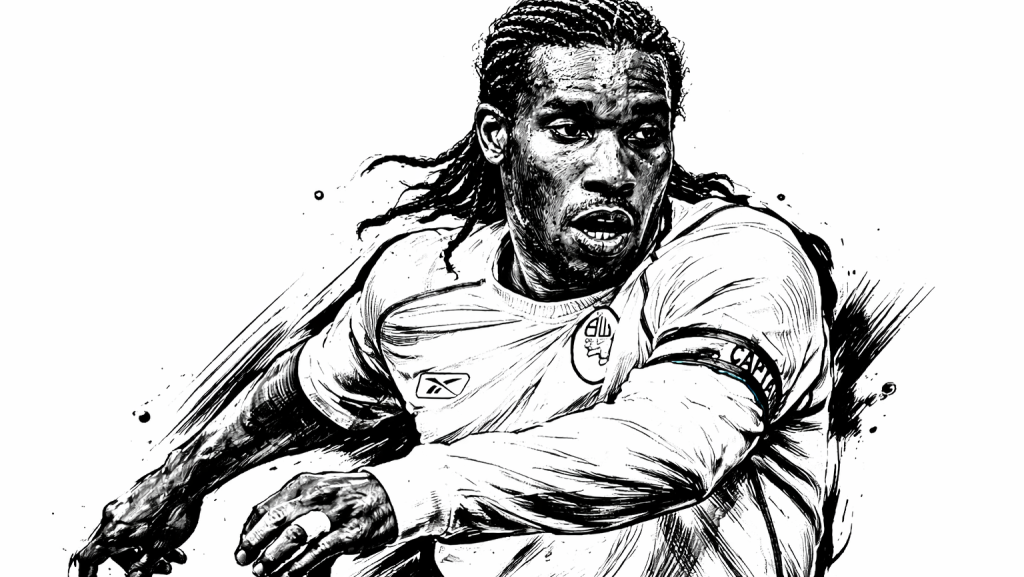
Long before the sport was cut into clips and loops, Jay-Jay Okocha played in a way that seems almost designed for replay. The first thing that stands out is not a number. It’s the pause he creates. A defender shifts, Okocha waits, the ball stays close, and the move opens from there. Even now, the footage feels current because his football was built on visual surprise, not just outcome.
That’s what makes him such a useful player to revisit now. Okocha’s career can be told through the usual checkpoints, Eintracht Frankfurt, Fenerbahçe, Paris Saint-Germain, Bolton Wanderers, Nigeria, but the larger story is about expression at the highest level. He was not a street player who happened to reach the professional game. He was a top-level footballer who kept some of street football’s freedom after arriving there.
The record supports the scale of the career. He won the Africa Cup of Nations with Nigeria in 1994, helped Nigeria win Olympic gold in 1996, played at three World Cups, and became central to one of the most memorable Nigerian teams ever assembled. FIFA’s ranking archive still shows Nigeria’s highest-ever men’s ranking as fifth in the world, which remains a marker of how serious that era was.
He also produced moments that survive outside nostalgia. FIFA’s own retrospective on Nigeria’s 1994 loss to Italy notes that Okocha completed 15 dribbles in the match, the most in a single World Cup game. It is the kind of detail that matters because it places his artistry inside an official record, not just memory.
His club path adds another layer. In Germany, he scored the goal that still defines his early myth, the slaloming move past Oliver Kahn for Eintracht Frankfurt in 1993. In Turkey, he was startlingly productive, scoring 30 league goals in 62 matches for Fenerbahçe. At PSG, he became part of a period the club still treats as culturally significant. Then in England, he gave Bolton something larger than survival. He gave the club a different identity.
More than a highlight player
That point matters because Okocha is often reduced to the reel. The reel is real, but it is incomplete. Premier League records show he made 124 appearances for Bolton, scoring 14 goals and adding 11 assists. Those numbers do not tell the whole story, but they do underline a useful distinction. He was not simply decorative. He was durable, influential, and productive enough to shape a team over time.
His Nigeria career deserves the same seriousness. The 1996 Olympic title was not a novelty. It remains one of the most important achievements in African men’s football, and Okocha was one of the players who gave that side both rhythm and nerve. Years later, he was named the best player at the 2004 Africa Cup of Nations, proof that his authority extended well beyond the early flash of his rise.
What lasts, then, is not just flair. It is authorship. Okocha played as if every possession could be personalized. He could slow a match without dulling it. He could improvise without losing control. In a sport that often rewards standardization, he kept room for invention. That is why the old footage still feels fresh. It is not because it resembles the modern game. It is because so much of the modern game still looks like it is trying to recover what players like him already had.
For a player so often remembered through aesthetics, the clearest conclusion is also the simplest one. Jay-Jay Okocha was not ahead of his time because he predicted football’s future. He was ahead of it because he proved that elite football could still look personal, loose, and alive. The technology changed. The feeling did not.