
When Aaron Ramsey confirmed his retirement, it closed a career shaped as much by resilience as by reputation. He leaves the game with 86 caps and 21 goals for Wales national football team, a record that reflects both longevity and influence at the international level. His club career carried similar weight, particularly during his years at Arsenal F.C., where he evolved into one of the Premier League’s most reliable midfielders.
Yet Ramsey’s story has long carried an unusual second thread. Over time, a pattern was drawn between several of his goals and the deaths of high-profile public figures. The connection was never grounded in evidence, but it persisted as a recurring narrative alongside his performances on the pitch.
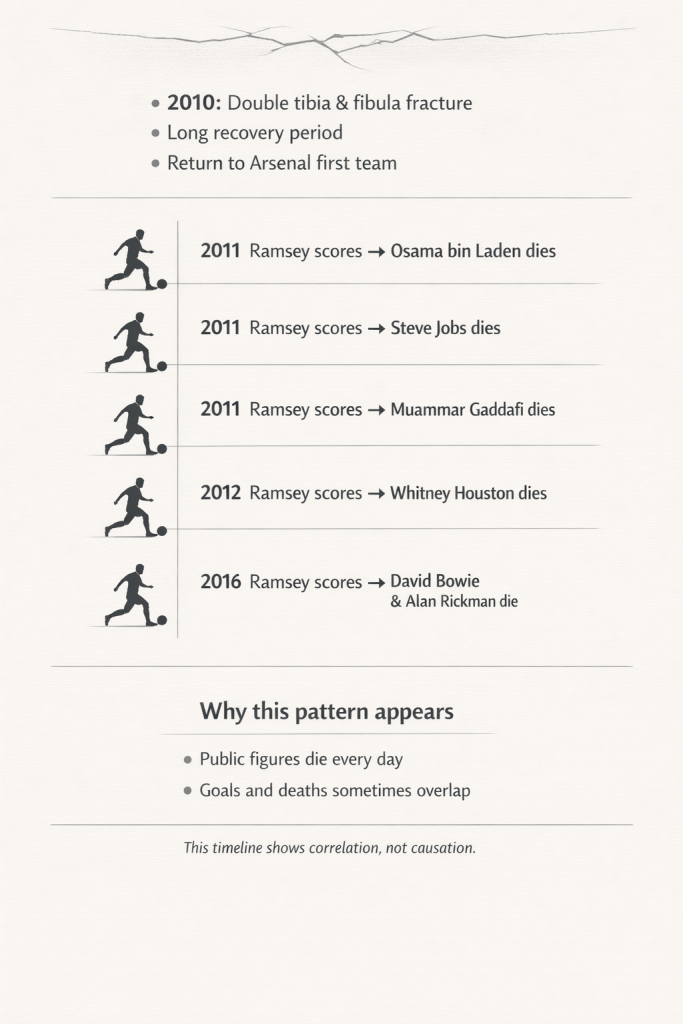
To understand why that idea took hold, it helps to start with the defining interruption of his early career. In 2010, Ramsey suffered a double fracture of the tibia and fibula, an injury that halted his development at a critical stage. His recovery was long and uncertain, and when he returned, his scoring record resumed in bursts rather than steady progression. That irregular rhythm created clusters of goals that later became the foundation for the pattern that followed.
Between 2011 and 2012, several of Ramsey’s goals were noted in proximity to widely reported deaths. Among the most frequently cited are Osama bin Laden, Steve Jobs, Muammar Gaddafi, and Whitney Houston. In later years, the list expanded to include names such as David Bowie, Alan Rickman, Robin Williams, and Stephen Hawking.
The pattern was never formally defined. Some versions required deaths to occur within hours of a goal, others allowed for several days. The list of names varied depending on those boundaries. What remained consistent was the structure, a goal, followed by a notable death, repeated often enough to feel intentional.
A pattern built from coincidence
The most grounded explanation lies in probability rather than prediction. Public figures die every day, and professional footballers score goals every week. When those two timelines overlap, coincidences are inevitable. The perception of a connection depends on how the events are grouped and remembered.
Academic analysis has framed this type of pattern recognition as apophenia, the tendency to perceive meaningful relationships in unrelated data. A related concept, illusory correlation, describes how repeated pairings can create the impression of causation even when none exists. Applied here, the structure is straightforward. A memorable football moment becomes linked with a widely reported death, and the pairing is reinforced each time a similar sequence appears.
Ramsey’s career arc helped sustain that structure. His return from injury coincided with a productive spell in front of goal, particularly during the early 2010s. Those goals, arriving in clusters, provided multiple opportunities for coincidence to be observed and recorded. Over time, the list grew, and the pattern appeared more complete than it actually was.
There is no evidence that Ramsey’s injuries themselves were tied to any such sequence. The association remained anchored to his goals, not to the setbacks that interrupted his playing time. His injuries instead shaped the pacing of his career, influencing when and how often those goals occurred.
His retirement changes that dynamic. Without the recurring trigger of a new goal, the sequence loses its mechanism for continuation. What remains is a fixed collection of coincidences, tied to a specific period in football history and to a player whose career intersected with it.
In that sense, Ramsey’s departure does not confirm or extend the pattern. It closes it. The narrative that followed his goals now stands as a self-contained artifact, shaped by timing, memory, and the human tendency to connect events that were never truly linked.